Rabu, 06 Maret 2013

ORANG-ORANG DI TANAH ABANG


Perut ini masih sama kosong
Langkah ini mungkin melambat
Tapi api kulihat di tanah abang
Orang yang bersemangat dan berpeluh
Berjuang bersenggolan, menyibak jalannya

Ditangannya berbuntel2 kain warna warna
Sekotak sarung mungkin ada juga
Meski peluh bercucuran

“Awas! Awas! Awas!, air panas mau lewat”
Kuli angkutpun bermandikan api
Pengharapan, sebuah puncak kejayaan

Berkarung uang akan kudapat sampai sore merah nanti
Menghitung laba yang sudah terbayang dimata
Setahun dalam bara
Sebulan ini dilalap api.......

Aaah orang berjualan es buah benar menggoda selera
Ibu ibu melirik penuh minat, peluh bercucuran, kerongkongan kering menawar
Aaah godaaan, teringat tabungan setahun yang sebentar lagi akan disetor pada
Tanah Abang

7/9/08

TEMBANG TEGUH


Ketika aku menyusut,
Merengut bagai kain yang kusut
Dalam angan penuh tanya
Kenapa bintangku tak jua datang
Matahari entah kemana

Slalu kedendangkan tembang teguh
Kusebut namaMu, kusebut namaMu
Dalam yakin aku berserah
Dalam tanya, slalu kuingat namaMu
KuasaMu seluas lautan tak berbatas
Yang hanya segenang kecil air  tanahmu yang maha luas

Dendangku, mohonkan berirama
Dendangku melipur lara
Dendangku menyusun kawat2 beton
Meripuh dalam susunan waktu
Membangun dinding yakin

Yang kuharapkan hanya ridhoMu
Yang kuinginkan hanya surgaMu
7/9/08


KETIKA KUDISENTUH


Ketika tanganku disentuh….
Oleh sapaan dan ciuman kecil…
Merana dada tersiram bahagia
Betapa sangat sederhana
Keajaiban sebuah sentuhan...
Bocah2 berkerudung ceria
Memanggil-manggil nama...
Aku bahagia

6 /9/08


Selasa, 05 Maret 2013

TEA WALK DI GUNUNG MAS TEA ESTATE, PUNCAK-BOGOR

Di akhir tahun 2010 lalu, saya dan teman-teman kantor pergi ke Gunung Mas Tea Estate di Puncak, Bogor. Jalan-Jalan diantara kebun teh atau yang lebih keren disebut tea walk merupakan pilihan kami untuk menjalin dan memperkuat  keakraban dan kekompakan kami. Jadi akhir tahun merupakan saat yang tepat untuk pergi bareng-bareng karena biasanya aktifitas kantor sudah mulai agak berkurang menjelang penutupan tahun.

Sore setelah pulang kantor, kami naik ke puncak, bogor, dengan tujuan salah satu penginapan disana. Sebagai makan malam, bapak-bapak mengusulkan agar kita bisa mencicipi sate kambing kadir 1 yang konon sudah terkenal enak. Setelah istirahat malam, pagi-pagi  kita bergerak ke Perkebunan Teh Gunung Mas Bogor. Di lokasi tersebut, pertama-tama rombongan diharuskan untuk melapor ke kantor perkebunan dan membeli tiket terlebih dahulu. Setiap tiket, kita mendapatkan bonus 1 bungkus teh hasil perkebunan tersebut. Betul juga, kita berkunjung ke kebun teh, sebaiknya kita mencicipi teh hasil perkebunan tersebut.

Pihak Perkebunan teh sudah menyediakan pemandu kepada setiap rombongan yang berniat untuk tea walk. Traif untuk pemandu tersebut tergolong murah, saya lupa tepatnya, tetapi dibawah  Rp. 50.000. Ada 3 pilihan rute untuk tea walk, rute pendek, sedang maupun panjang. Rute pendek menempuh rute 4 km, rute sedang 6 km dan rute panjang 12 km. Kita memilih rute pendek saja karena setelah tea walk tersebut, masih terdapat acara lain.


Kontur perkebunan teh yang naik turun merupakan sebuha tantangan tersendiri bagi kami yang tidak terlalu terbiasa dengan kondisi tersebut. Tetapi semua kelelahan terbayar dengan kesegaran udara,pemandangan hijaunya kebuh teh dan alam pegunungan. Sepanjang jalan, bapak pemandu menjelaskan kepada kita mengenai sejarah perkebunan, jenis-jenis pohon teh dan produk olahan teh maupun proses pengolahan daun teh dari pemetikan sampai hasil jadi. Salah satu produk Perkebunan teh Gunung Mas merupakan teh dengan Merek WALINI. Teh tersebut dikemas dalam berbagai varian, seperti teh hijau, teh rasa jahe dll. Sebagai oleh-oleh, jangan lupa untuk membeli salah satu produk kebanggan  Indonesia tersebut. Perkebunan teh tersebut juga menyediakan berbagai fasilitas selain untuk tea walk, terdapat juga fasilitas untuk camping, berkuda, kolam renang dan lokasi rekreasi. Di komplek perkebunan teh tersebut juga terdapat cafe yang menyediakan teh dan makanan kecil lainnya yang enak bila dinikmati hangat-hangat. Keindahan dan kesegaran kebun teh merupakan alternatif wisata yang patut dicoba dan dinikmati bersama keluarga.

MENENGOK ANGKUTAN LINTAS BATAS NEGARA INDONESIA-MALAYSIA-BRUNEI DARUSSALAM


Bus Damri rute Pontianak-Serawak-Brunei

Disela-sela menghadiri pertemuan di Bandar Seri begawan pada tahun 2009, saya dan rombongan menyempatkan diri untuk menengok angkutan lintas batas negara Indonesia-Malaysia dan Brunei Darussalam. Tentu saja, kegiatan tersebut difasilitasi oleh KBRI Brunei Darussalam.

angkutan antar negara
aktifitas menjelang keberangkatan bus di Bandar Seri Begawan
Angkutan lintas batas negara yang menempuh rute Pontianak (Kalimantan Barat, Indonesia)- Kuching (Serawak-Malaysia)-Bandar Seri Begawan (Brunei Draussalam) tersebut merupakan implementasi dari Kesepakatan Kerjasama Brunei Darusalam-Indonesia-Malaysia and the Philipines East ASEAN Growth Area (BIMP-EAGA) di bidang angkutan lintas batas bis Komersial (BIMP-EAGA Memorandum of Understanding (MOU) on Cross-Border Movement of Commercial Buses and Coached) yang ditandatangani oleh para Menteri transportasi Negara BIMP-EAGA di Singapura pada tanggal 2 Nopember 2007.

Pengoperasian angkutan lintas batas negara dimana dari pihak Indonesia antara lian dioperasikan oleh PERUM DAMRI yang dimulai sejak bulan Nopember 2008 tersebut melintas jarak sekitar 1.200 km dengan waktu tempuh sekitar 26 jam. Setiap hari, sekitar pukul 8-10 malam, satu bus DAMRI berangkat dari Pontianak menuju Bnadar Seri Begawan, sedangkan keberangkatan dari Bandar Seri Begawan adalah  jam 4 sore.  Ongkos yang harus dikeluarkan oleh masing-masing penumpang adalah Rp. 550.000 (lima ratus lima puluh ribu rupiah) atau 80 ringgit Brunei.

Fasilitas bus terbilang cukup nyaman karena dilengkapi dengan Air Conditioner, kapasitas tempat duduk 28 seat, toilet dan ruang merokok. Berdasarkan info dari sopir bus DAMRI, dalam perjalanan, bus akan berhenti 3 kali dan penumpang diberi fasilitas makan 1 kali. Guna menjamin keamanan dalam perjalanan serta mendukung kelancaran perjalanan bus, KBRI Brunei meminta agar dalam bus dipasang pengumuman mengenai jenis-jenis barang yang dilarang masuk ke Brunei Darussalam.

Antusiasme masyarakat baik masyarakat Indonesia maupun Brunei Darussalam terhadap beroperasinya angkutan yang melintas pulau Kalimantan ini sangat besar. Hal ini terlihat dari load factor bus yang rata-rata lebih dari 50% setiap harinya. Selain para TKI yang bekerja di Brunei, angkutan tersebut juga sangat diminati oleh masyarakat Brunei Draussalam maupun Pontianak yang hendak melancong dan meniknmati keindahan pulau Klaimantan dari dekat.

Keberadaan angkutan lintas batas tersebut selain memperlancar pergerakan penumpang antara negara, juga merupakan sarana untuk lebih mendekatkan masyarakat serumpun tiga negara yang berbatasan darat yaitu Indonesia-Malaysia dan Brunei Draussalam baik dari segi sosial, ekonomu maupun kebudayaan, sebagaimana yang dicita-citakan melalui kerjasama wilayah pertumbuhan ekonomi Brunei Darussalam-Indonesia-Malaysia-Philipina.

(note: tulisan ini dibuat tahun 2009)
Berfoto dengan sopir dan kondektur bus damri

COACHING AND NETWORKING IN THE ASEAN TRANSPORT COOPERATION


 INTRODUCTION

The Association of South-East Asia Nations or ASEAN is a regional cooperation organization in the dynamic region of South East Asia, established in 8 August  1967 and comprises of 10 nations namely Brunei Darussalam, Cambodia, Indonesia, Lao PDR, Malaysia, Myanmar, the Philippines, Singapore, Thailand, and Vietnam. Initially, the Organization established by five nations of Indonesia, Malaysia, the Philippines, Singapore and Thailand, later Brunei Darussalam, Vietnam, Lao PDR, Myanmar and Cambodia  joined the group. The important role of ASEAN for its region is not only by creating stability and peace, but also in  its 41 years of establishment, ASEAN has proven its self as one of an important moving engine for the economic development in its member states to realized the prosperity of the people of South East Asia region.
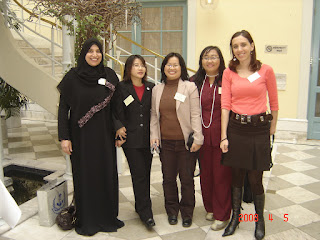
The Speakers: WMU Class of 2004 


Presently, ASEAN cooperation has moved toward a new significant development by its vision to build ASEAN Community in the year of 2015 in the effort to create sharing community under one vision, one identity and one caring. It also has strengthened by the establishment of ASEAN Charter on 20 November 2007 as a legal and institutional framework of ASEAN. Thus ASEAN Community which comprising of ASEAN Economic Community, ASEAN Security Community and ASEAN Socio-Cultural Community could be realized.

In the area of economy cooperation, an efficient and integrated transport system is a key for ASEAN to integrate with the global economy, improve competitiveness and enhance the inflow of foreign direct investment. Therefore, ASEAN Transport Cooperation is directed to intensify regional activities to enhance multimodal transport linkages and interconnectivity, promote the seamless movement of peoples and goods, promote further liberalization in the air and maritime transport services, and further improve integration and efficiency of transport services and the supporting logistics systems. Furthermore, the cooperation is also hoped to give a significant contribution to make a solid foundation for ASEAN economic integration internally. One of a vital part of that integration is by linking ASEAN economies and societies more closely and strongly together by building, upgrading and improving transport networks among ASEAN member countries, making them work better and less expensively. A good and efficient transport makes contact between people quicker and smoother.

COACHING IN ASEAN TRANSPORT COOPERATION

ASEAN  objective to  establish ASEAN Economic Community by the year of 2015 is  definitely not an easy job. According to its blue print, ASEAN has to implement  a single market and production base in the South East Asia region, make it as a competitive region economically, creating an equitable economic development for all of its member states and ready to make a full integration into the global economy. These goals are a real challenges for ASEAN. Internally, it is not only because of a different economic development of its member states, but ASEAN has also need to establish several agreements in order to facilitate integration among them, which takes a lengthy process and negotiation. Therefore, ASEAN is seriously taking every effort to strengthen its cooperation and coordination, among the member states as well as with its dialog partners.

In order to develop South East Asia to become a strong economy region, ASEAN member states  has to support each others in the process, considering their different economic development. In this regard, countries which are more developed, couching or assisting countries less developed, through capacity building and share of knowledge. This two activities are greatly important and become a common practices, so that ASEAN member countries could achieve the equal level of development.

In ASEAN transport cooperation, these practices have been proven to be highly effective. It could be seen in the significant development in transportation capability of ASEAN member countries particularly for the countries which joining ASEAN in  a latter stage. Presently, instead of their equal right as a ASEAN member countries, their capability have greatly improved so that they could cooperate better as a member of ASEAN.  Coaching in ASEAN transport cooperation also conducted  by ASEAN dialogue partners for ASEAN member countries. In the transportation sector, ASEAN has established  cooperation with Japan and China. ASEAN cooperation with these two countries are conducted in  ministerial as well as senior officials levels. Under this cooperation, several capacity building and share of knowledge between ASEAN and its dialogue partner are also established.

In order to establish integration among its member states, ASEAN transport cooperation has to through a lengthy negotiation to establish several framework agreement which create  rules in transportation sector which shall be followed by its member countries. Due to a different domestic policy of its member countries in the implementation of ASEAN transport agreement, therefore ASEAN has established a scheme called ASEAN minus X Formula. If one or two member countries are ready for the implementation of the agreement, they could firstly  proceed and others member countries could follow later when they are ready. This formula is established to facilitate countries that need more time to implement ASEAN policy, without preventing others which are ready to implement.

NETWORKING IN ASEAN TRANSPORT COOPERATION

Networking in ASEAN transport cooperation is conducted through physical network and electronic one. The physical network is done with regular meeting among its member countries as well as with its dialogue partner. The meetings are ministerial, senior officials, working group and sub-working group levels. ASEAN Transport Ministers (ATM)  Meeting  is a meeting of ASEAN transport ministers and also with minister of transport of their dialogue partners, conducted  every year. ASEAN Senior Transport Officials Meeting  (STOM) is done twice a year. The senior officials meeting report to the ministerial meeting to seek for guidance and for adoption of their works. In the working group level, ASEAN has four working group namely, ASEAN Land Transport Working Group (LTWG), ASEAN Maritime Transport Working Group (MTWG), ASEAN Air Transport Working Group (ATWG) and ASEAN Transport Facilitation Working Group (TFWG). These working groups are usually met twice a year before the Senior Transport Officials Meeting or as decided by the decision of the working group meeting. ASEAN Highway Sub Working Group Meeting is the sub working group under ASEAN Land Transport Working Group. Usually this meeting are conducted back to back with  its parent working group or as decided by the meeting.

Aside of physical networking, ASEAN transport cooperation also has electronical network through email. They have established email network to make a communication to each other member states. In this regard, ASEAN Secretariat is playing its role in spreading the information  especially prior to a meeting or to seek consultation on a certain matters which need  concurrent from a member states. In this way of communication, ASEAN member countries have appoint contact person and email address. ASEAN member countries also could directly communicate with each others by  sending email to every member states.

CONCLUSION

The Speakers at lunch break
As a organization of the countries in the  dynamic region in the South East Asia, ASEAN has played an important role to strengthened  the cooperation in the region. ASEAN transport cooperation is one of the key to integrate ASEAN to the global economy. Due to a different economic development of its member states, ASEAN has established mechanism in coaching or assisting less developed countries to catch up the development of others member countries so that the equitable  economic development could be achieved. The mean for cooperation is by networking which is done physically through regular meeting and electronically through email.     


( Note: This Short writing was submitted to the Seminar on " Empowering Professional Women in the Maritime World" held in Malmo, Sweden on 2-4 April 2008)


INDONESIA-JAPAN BILATERAL COOPERATION IN TRANSPORTATION SECTOR: a Tokyo Visit


It was just after I had arrived at Prince Park Tower Hotel- Tokyo, a colleague from the Indonesian Embassy in Tokyo approached me and said, “ When you have a time, please do call Mr. Kudo  from the OPRF , he is waiting for you to contact him.” It was quite a surprising message for me, since to be frank, I did not inform Mr. Kudo of my visit to Japan. How could he detected my presence? 

Mr. Kudo, My self and Mr. Tomoya, a brief talk in Tokyo
The reason why I did not inform Mr. Kudo that I am in Tokyo was because  I was afraid that my tight schedule in attending “The 2nd Vice Ministerial Level Meeting in Transportation Sector Between Indonesia and Japan” held in Tokyo on  28-29 July 2011, did not give me any opportunity to do any spare activities but working.  The success of this annual meeting between the Ministry of Transportation of the Republic of  Indonesia and the Ministry of Land, Infrastructure, Transport and Tourism (MLIT) Japan on Vice Ministerial Level is one of my duty as Chief of Bilateral Cooperation in the Ministry of Transportation of Indonesia. But then, thanks God, I had a chance to meet with Mr. Eisuke Kudo and Mr. Tomoya Shimizu (MA 2004) after a farewell dinner of the meeting. We were having a nice chats while observing the view of Tokyo Tower and Tokyo at Night, from the 33rd  level of Prince Park Tower Hotel. This visit was a real meaningful experience for me since it was my first visit to Tokyo again after 8 years since my  Japan field study in 2003 during my study in WMU.
  
The 2nd Vice Ministerial Level Meeting in Transportation Sector Between Indonesia and Japan is an initiative to strengthened the existing bilateral cooperation in transportation sector between the two countries. Indonesian delegation was led by H.E. Bambang Susantono, Vice Minister for Transportation and Japan delegation was led by Mr. Seiichi OHKUCHI, Vice Minister for International Affairs. During the meeting, ways to enhance cooperation in aviation, port  and railways sectors were seriously discussed.  Japan delegation also presented “Recoveries of Transport Infrastructure from Great East Japan Earthquake”.  As we all know, Japan and Indonesia are countries that lied on the ring of fire, thus earthquake is a natural disaster that we often experienced. So Indonesia side needs to learn from Japan  on how transport infrastructure could be fast recovered to support the movement of people and aids as well as to support the economy recovery in the disaster area.

This annual meeting will take place in Indonesia or in Japan subsequently every year. In this case, I have an opportunity to visit Japan at least once in every two years to attend this meeting. And it makes me happy.

(Note: This Short Article has already published in the Friends of WMU Japan  Newsletter Number 37 on December 2011 )